
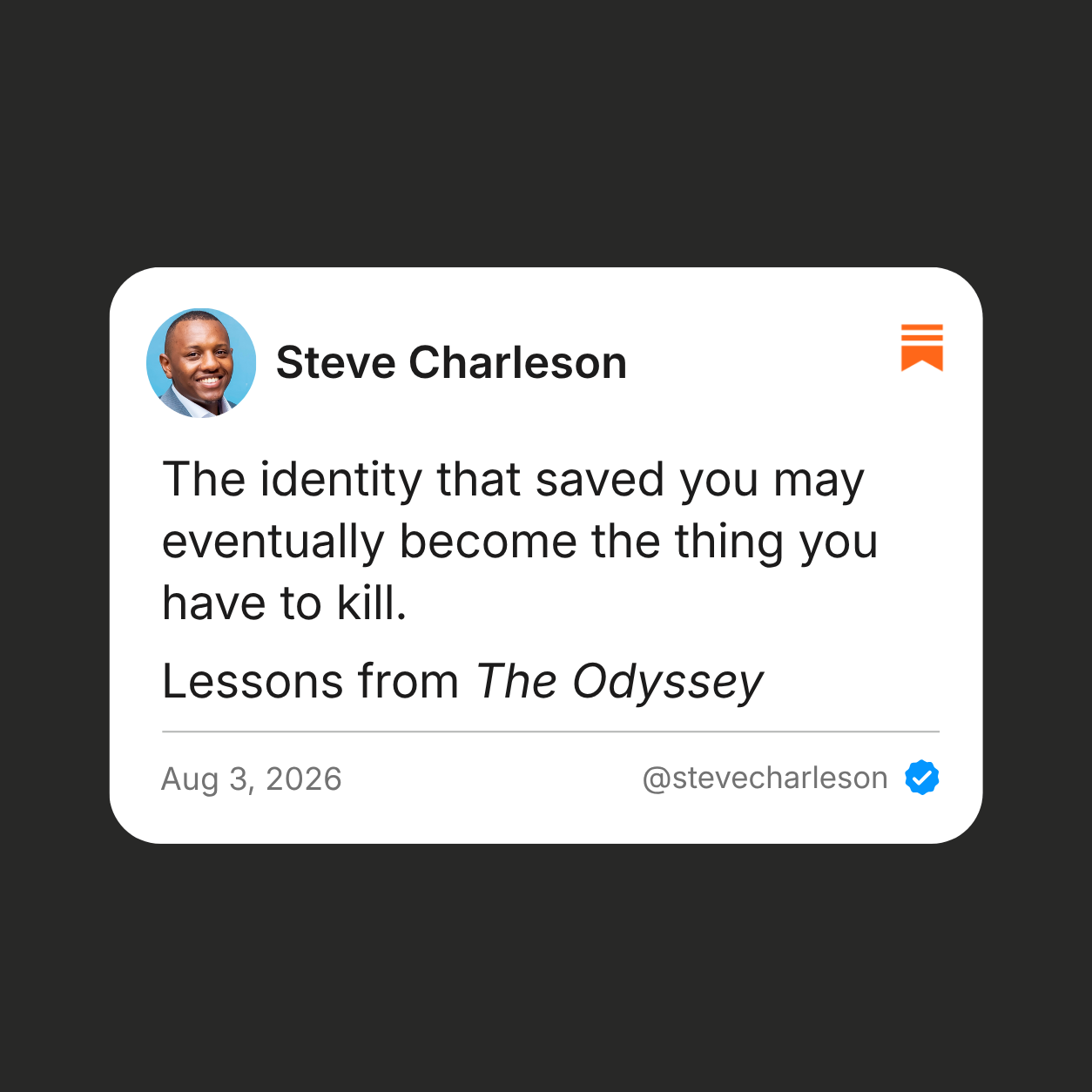
The identity that carries you in one season of life may be an identity you need to be free of in the next.
I watched The Odyssey not long ago, and I found myself dwelling not so much on the mythology that underpins the story, but rather on the psychology at work.
Odysseus spends years at war… and manages to survive through intelligence, aggression, deception, endurance, and an obsessive tenacity to get home. Or at least a man you wouldn’t want to be fighting alongside. However, the interesting part starts after the war. And then the journey home becomes a different sort of battle.
Certainly there are monsters, there are temptations, and there are storms, and there are gods, but a lot of what Odysseus faces can also be viewed as a reflection of internal struggles: lust, greed, desire, pride, mourning, fear, nervousness, and longing to control that which is out of control.
That was strangely familiar.
In the early days of a business, many entrepreneurs create their own definition of the warrior. You become hyper-sensitive, because there is no one else monitoring the figures. You work tirelessly, because slowing down seems risky. You take ownership, because delegating meant something going wrong. You battle for every customer, because losing one contract truly jeopardizes the business.
There are occasions when that identity is all you need to survive.
It all starts when the situation changes, but the identity remains the same.
The business expands. A team is formed. Capital needs safeguarding, entities need establishing, lives rely on the founder’s discernment. Still, the founder acts as if there is a tomorrow.
The psychology that established the company begins to bind it.
I found it especially interesting that there seemed to be the notion that you simply cannot save people from themselves. There are a bunch of characters that Odysseus wants to bring home, care for, or convince, but in the end they have their own will power and desire that they have to deal with. Likewise, the boundary of leadership is:
You can advise a person. You can set the conditions for his success. You can tell him what it will be. But you cannot want his transformation more than he does.
There is also something being exposed about desire and hunger. The enemy is not always what is clearly evil. Sometimes it is what appears to be beneficial: honor, reward, satisfaction, acceptance, strength, reprieve.
And at last Odysseus learns something even more difficult.
Some storms are too big to beat with brutality.
There comes a time when you have to let go of the illusion that everything can be controlled.
That thinking has resonated with me because my entrepreneurship path has gone through a similar transition. There were times when performance, bandwidth, and the need to carry everything by myself were required. The person who makes it through crisis isn’t always the person who should decide what happens post-crisis.
This is one of the things I have been writing about and preparing for in the years to come, in my book Killing Goliath, for quite some time now.
The book is essentially a study of what occurs when the adaptations that once saved us hold us back from becoming the kind of people who will create the next stage of our evolution. I am in the process of working through several of these concepts as well. Maybe that is why I identified with The Odyssey so strongly.
The final battle is not necessarily with the giant outside of you. There are instances when it is against the identity you’ve constructed to beat him.
The war was over. The warrior wasn’t.
Additional on Killing Goliath to follow soon.